
The Murder of Daniel Mendoza - Part 2
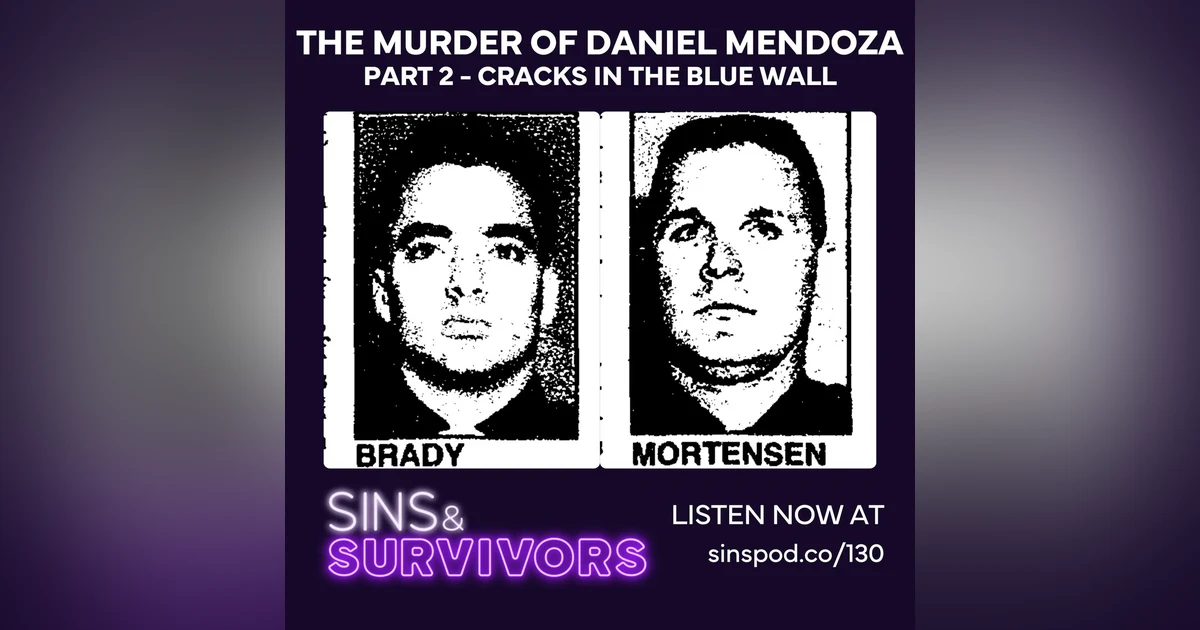


In this week's episode, we're going through the timeline of what happened in the shooting of Daniel Mendoza on December 29th, 1996. Two police officers had wildly different accounts of what happened that night. Who, if anyone, was telling the truth?
https://sinspod.co/130
https://sinspod.co/130transcript
https://sinspod.co/129sources
Become a supporter of this podcast: https://www.spreaker.com/podcast/sins-survivors-a-las-vegas-true-crime-podcast--6173686/support.
Domestic Violence Resources
http://sinspod.co/resources
Click here to become a member of our Patreon!
https://sinspod.co/patreon
Visit and join our Patreon now and access our ad-free episodes and exclusive bonus content & schwag! Get ad-free access for only $1 a month or ad-free and bonus episodes for $3 a month
Apple Podcast Subscriptions
https://sinspod.co/apple
We're now offering premium membership benefits on Apple Podcast Subscriptions! On your mobile device
Let us know what you think about the episode
https://www.buzzsprout.com/twilio/text_messages/2248640/open_sms
The Murder of Daniel Mendoza - Part 2
Shaun The shooting on McKellar circle lasted only a few seconds, but the investigation that followed would stretch on for decades. By the time the sun rose on December twenty eight, nineteen ninety six, Daniel Mendoza was dead. Witnesses were searching for a blue pickup truck and two off duty Las Vegas Metro police officers were trying to decide what to do next.
John Neither one immediately contacted colleagues. Neither rushed to report what had happened. Instead, over the course of a long and increasingly complicated weekend, the two partners began telling very different stories about that same night. These competing stories would ultimately shape one of the most controversial murder prosecutions in Las Vegas history.
Shaun Hi, and welcome to Sins and Survivors, a Las Vegas true crime podcast where we focus on cases that deal with domestic violence as well as missing persons and unsolved cases. I'm your host, Sean.
John And I'm your co-host, John.
Shaun Last week, we left you on a dark street corner with a father, Ramon Mendoza, Asking a question that would echo through the city for decades. Why do you do nothing when my son is shot? At that moment, Metro officers were photographing and fingerprinting Daniel's grieving friends and neighbors while investigators searched for a blue Dodge pickup truck. What Ramone didn't know was that the truck was already tucked away in a residential driveway across town at a home belonging to a Metro police officer.
John As we shared last week, on December twenty eight, nineteen ninety six, Las Vegas metro officers Ron Mortensen and Chris Brady were out having fun on the night of Ron's thirty first birthday. Both had been drinking heavily and were going into distressed neighborhoods and intimidating people because they felt like it. As Brady put it later, they were harassing the vagrants and the bangers and the dopeheads and all the screwball people. Shortly after midnight, they pulled up outside twenty one year old Daniel Mendoza's apartment building, and several shots were fired before the pickup peeled off, leaving his grieving father, fiance and friends shattered as Daniel died on the pavement outside his home. Over the next forty eight hours, the investigation into who killed him would fracture the blue wall of silence we've come to expect to form around the partners. In case you missed part one, The Dreamer and the Thin Blue Line, we recommend you go back and listen to that now. You can find it at censored dot co. One twenty nine this week we are continuing the story of the murder of Daniel Mendoza by examining the two radically different accounts given by Brady and Mortensen. We want to make it clear from the start that we're not speculating on what happened. The content of this episode comes from court records, testimony and over one hundred and fifty news articles we read to research this case from both newspapers dot com and the Las Vegas Review Journal archives. All our sources are public and for this series we placed clippings of the articles in a folder online. You can find that at snspa dot one twenty nine sources.
Shaun To understand the complete breakdown of that weekend, we have to backtrack to the evening of Friday, December twenty seven, nineteen ninety six. The partners were off duty out celebrating Ron Mortensen s thirty first birthday. After dinner games of pool, beers and shots of tequila, both Brady and Mortensen were drunk before they left the birthday party to head out to a local bar. Mortensen handed his wife his fanny pack, but before he handed it over, he reached inside, pulled out his personal weapon, which was a three hundred eighty SIG Sauer handgun. When he got into Brady's truck, he tossed it directly on the front bench seat, sliding it under his left hip. Christopher Brady already had his own off duty gun, which was a thirty eight Taurus revolver stuffed in the bottom right front pocket of his coat. The two of them climbed into Brady's custom blue nineteen seventy four Dodge pickup with heavy, dark window tinting on every window except the front windshield. The truck also had a custom front seat, according to court records, the truck had a bench seat that had two independent chairs for the passenger and also for the driver, and a center console seat that folded down and also had a compartment under that middle seat. Brady took the wheel. Mortensen climbed into the passenger seat, and the two cops set out on what Brady later casually described to investigators as a tear through gang neighborhoods where they could target the bangers and the dopers in the neighborhood. Because, as he said, they were nasty people. In his own words, Brady told investigators they were driving around recklessly, cutting through alleys and pulling one eighty. He testified that they pulled into a 7-Eleven parking lot just to purposely stare down and harass a man using a payphone until he got nervous. At one point, he also sped past a group of people, passing them real close. But according to Mortenson's version of events that night, everything was Brady's idea, and he was not a willing participant and wanted the evening to end. Mortenson swore that they stopped to withdraw cash at an ATM and pulled into a gas station, where he told Brady he felt sick, he was too drunk, and he explicitly begged to call it a night and go home, Mortenson claimed. Brady responded by saying, whatever, hey dude, I got an idea. Let's go harass some Mary Norris Groat. According to court records, Scrote was a derogatory police slang for certain residents. Although I don't think you need Mortensen or Brady or me to explain that to you. Mary Nora refers to the department's name for that sector or police beat. Brady then struck him in the shoulder with a club, telling him, you're not going home yet. We are going out to the bar and do some drinking, but first I want to trip something out. Brady drove erratically through the neighborhood. The two of them were laughing at Brady's driving. Mortensen said he asked where they were going, and Brady said, dude, hold on, and sped into the cul de sac at McKellar circle. But according to Brady, while he drove down the street, it was Mortensen who told him, stop, pull in the alley. So right from the start of the story, you hear the finger pointing and the way their two stories diverge.
John As we shared last week, a group of neighborhood youth, including twenty one year old Daniel Mendoza, was gathered outside when Daniel's friends saw the truck pull over in front of the building. They immediately suspected that these were narcs or police officers. Both officers agreed that the passenger side of the car was facing the apartment complex. What happened next is still disputed to this day. We'll start with Brady's statements and testimony, according to him. Mortensen did not say anything. He drew his firearm and stuck it out the passenger window. Brady, being a cop, saw Mortensen do this and assumed that there was some kind of threat. He then drew his own gun out of his pocket and leaned across the seat with the gun about six inches from Mortensen's chest, also pointing his gun out the window. As we said earlier, the front seat had a console in the middle, and Brady said that the center console seat was down at the time of the shooting, so he could not reach over far enough to have his gun or his hand reaching outside of the window. Brady testified that he realized the group didn't have any weapons, so he just dropped his gun. As he drove away, Mortensen fired into the group of friends. As the two fled, Brady asked Mortensen why he had fired the shots, and Mortensen said he had shot at the trees or the building.
Shaun Mortenson, on the other hand, gave this account. As we mentioned, these statements come from court documents and testimony. And what I'm about to share here are all things that Mortenson claimed Brady said or did. As they pulled up to the apartment building, Brady said, ah, look what we have here. And told Mortenson to roll down his window. Brady called out to Daniel and the group of friends. Come here. Mortenson then said, come on Chris, let's go. This is stupid. Brady then told him look out and came across the seat, elbowed Mortenson in the chest and put his arm out the window. Fired one shot, laughed, fired three more shots and said, run! You better run. According to Mortenson, he had tried to stop Brady, but Brady told him to let go. Brady then drove away off to the pub. As they were driving, Mortenson asked Brady why he had fired and Brady's response was that son of a bitch had a gun and you just sat there. Mortenson told Brady that he hadn't seen a gun. According to Mortenson, Brady explained that he shot into the air and said, dude, nobody comes up on me like that. I was just trying to scare him. Mortensen claimed he looked over and shockingly realized that Brady was holding Mortensen's own three hundred eighty six hour handgun between his legs and his crotch area. Mortensen demanded to know why he used his gun, and Brady replied that he couldn't reach his own Taurus in his heavy coat pocket. Brady then lifted the middle section of the custom bench seat, shoved the murder weapon into the hidden center console compartment, and slammed the armrest down over it. Brady then told him, I hope you don't plan on keeping this gun. I'm going to get rid of it, Mortensen told Brady. You are crazy, and asked why he shot at the group, and Brady told him not to worry about it and said, I told you I was an evil man, I am evil. When Mortensen panicked, thinking about how he was on probation with the force and that he was worried about his career, his wife and his infant daughter, Brady told him, it's just going to come out as a four three four call, which is the Metro Police code for an illegal shooting incident. Brady then drove them to Petty's in Spring Valley, a well well-known off duty cop, Barr and Brady told him to act. Natural. Witnesses there saw Mortensen visibly trembling and said after an hour and a half of drinking, one later claimed that Mortensen was saying he was going to quit Metro. Mortensen was so overwhelmed by panic and alcohol that he vomited heavily in the bar's parking lot and a second time at a nearby office complex before Brady finally drove him home. Brady would not let Mortensen have his gun back, he said. Brady told him again not to worry about it. When he tried to open the compartment and grab it, Brady put his elbow on the cup holder and said, don't worry about it right now. We're going to pause here for a quick break, but when we come back, we'll get to what happened when Chris Brady woke up the next morning.
John According to Christopher Brady's later trial testimony, he woke up on Saturday morning, December twenty eighth, and discovered Mortensen's off duty three eighty SIG Sauer handgun sitting in a rain jacket behind the passenger seat of his truck, Brady didn't report anything to his supervisors. Instead, he took the weapon inside his apartment, cleared the live round from the chamber, emptied the magazine and hid the fully wiped weapon in his bathroom cabinet. Mortensen swore under oath that he had spent the morning stressed and sick to his stomach, and Brady called him between ten and noon, laughing and bragging that they had party like Vikings the night before and completely leaving out any mention of the shooting. Brady has fiercely denied that that call ever happened. That evening, local news broadcasts broke the story that Daniel Mendoza had been shot and killed the night before, and that the police were searching for two white males in a blue or green pickup truck. Brady claimed that the story shook him up and he vomited. He then went to bed. On Sunday morning, December twenty ninth, Brady called Mortensen directly, accusing him. You shot the guy. According to Brady, Mortensen had first denied that had happened. But then he said he was sorry. Brady wanted to tell their supervisor what happened, but Mortensen asked him not to because he needed time to think. Mortensen asked to come over, but the realization hit Brady as to what he was facing. He didn't trust Mortensen. He was a witness to a murder, potentially a getaway driver or accessory holding a white murder weapon. So he told him, no, don't come to my apartment. Instead, the two agreed that later that evening, Mortensen would come pick up Brady at six p m to go to their night shift together so Brady wouldn't be seen driving the truck. However, Mortensen tells a different version of that Sunday morning phone call. According to him, when he told Brady about the killing, Brady said that he wasn't going to be arrested or locked up for something he didn't do. Brady said that he was just screwing around and that the shooting had been an accident. Maybe one of the bullets had ricocheted. Mortensen again told Brady that he was worried about his wife and his daughter, and Brady said that he was sorry. It's interesting, though, that each of them claimed that the other one said they were sorry. Mortensen said that the conversation mostly ended the way Brady said it had. They agreed to report it to their supervisor when they went into work that evening, Mortensen would come pick up Brady and the two would go in together, Brady told him not to do or say anything before then.
Shaun The decisions made over the next several hours would shape the course of the entire case. At some point on Sunday afternoon, Christopher Brady decided not to wait until the evening shift and instead reached out to his father, detective Mike Brady, a veteran metro officer who had been with the department since nineteen sixty nine. According to Mike, Chris called and said, dad, I need you. I need you over here right now. I was out drinking with Ron and that idiot Ron shot somebody. At five p m on Sunday, detective Mike Brady arrived at his son's apartment. Mike said that Christopher broke down in tears, collapsed to his knees and sobbed uncontrollably. Mike Brady donned gloves, placed Mortensen's gun into a bag and drove his son straight to the police station. He said he advised his son to tell the truth and help Mr. Mendoza have some closure with the death of his son. On Sunday evening, the head of homicide, Lieutenant Wayne Peterson, met the Bradys at the station. The recorded interview was conducted by Detective Brent Becker, a man who had historically worked surveillance operations side by side with Brady's father because of Brady's family connections with the department. The circumstances of the interview would later draw significant scrutiny. Christopher Brady was allowed to have his father sit in the room for emotional support. No defense lawyer was present. The interrogation lasted a mere eighteen minutes. Detective Baker later testified he didn't feel there was much more detail to get. Claiming Brady's story perfectly matched the scene. That was the one and only time Brady was interviewed. According to later testimony, field detectives initially sought a walk through booking that would have treated Brady as an accessory that did not happen. Metro argued that because Brady came voluntarily, he shouldn't be treated as a perpetrator. But strictly as a witness for the state, Brady walked out of the station completely free of charges. Mike Brady would later say that it was a lesson for the community that if a person unknowingly involved in a crime comes forward voluntarily to solve that crime, charges won't be filed, or at least will be greatly reduced. Meanwhile, when Mortensen arrived at Brady's apartment at six p m for their shift, he saw that Mike was there. He called the apartment, but he was told, presumably by Mike, that Chris Brady was not at home. Given that Mortensen believed he was being set up, so he left quickly to go say goodbye to his grandmother and consult his father in law, who told him he had to turn himself in. Mortensen then headed to the precinct to file his own report. But Metro arrested him the moment he stepped through the doors.
John With Mortensen in custody and being held on half a million dollars bail. The investigation continued to move forward, with Brady serving as the key witness. The crime lab towed Brady's truck, and according to court records, the examiner had been instructed by a homicide detective to process only the passenger side of the truck. It was returned to Brady just a day or two later. Once he had it back, an incredible sequence of events occurred that is almost hard to believe, given that the truck was part of a crime scene. On January fifteen, nineteen ninety seven, Mortensen's counsel made a desperate oral request for Brady's truck and clothing. The court explicitly requested that the state ask Brady not to destroy any evidence. One week later, at an arraignment on January twenty third, the court told the defense they were on their own. They would have to obtain those items through their own resources sometime within the next few weeks. Mortensen was able to obtain both the truck and the clothing. However, when the defense got them, the evidence trail raised significant questions. Chris Brady had fully admitted driving the truck that night. Yet by the time the defense fully gained access to those items, Brady's clothing had been washed. The custom bench seat that had been in the truck on the night of the shooting had been removed and sold to a third party. The truck had also been repainted, and the dark window tint had been completely stripped away from the side windows, and even the mechanical operations of the clutch and the carburetor had been adjusted within the first few days. The investigation had produced two completely different versions of that same night, Brady insisted that Mortensen opened fire. When they rolled into the neighborhood, Mortensen insisted that Brady had used his sig. Sauer leaned across him and pulled the trigger himself. Both men admitted that they had been drinking. Both admitted they were there and both accused the other of murder. Meanwhile, the immediate chain of evidence raised serious questions. The gun had been cleaned and wiped. The truck had been altered. The clothing had been washed. Key pieces of evidence were just gone, Brady would later say. He made his changes to his truck because he was afraid of retaliation from gang members if they spotted him driving the vehicle that had been used in Daniel's murder.
Shaun While investigators argued over witness statements and competing versions of events, one fact was never in dispute. Daniel Mendoza was dead. A father had lost his son. A fiancée would never get the wedding she had planned, and a family was left searching for answers. Next week, in part three, public outrage erupts across Las Vegas, community leaders demand accountability, and prosecutors begin building one of the most controversial murder cases in the city's history. As the trial begins, everything comes down to a single question who pulled the trigger? This isn't just a Las Vegas story. It's a story about power, accountability, and what happens when the people entrusted to enforce the law are accused of breaking it. While the names and places are uniquely Las Vegas, the questions at the heart of this story are not what happens here happens everywhere.
John Thanks for listening. Visit inspired dot co slash subscribe for exclusive bonus content and to listen ad free. Remember to like and follow us on Instagram, Facebook, TikTok and threads at Sens and survivors. If you're enjoying the podcast, please leave us a review on your podcast platform of choice. You can contact us at questions at survivors dot com.
Shaun If you or someone you know is affected by domestic violence or needs support, please reach out to local resources or the National Domestic Violence Hotline. A list of resources is available on our website and survivors dot com. And survivors. A Las Vegas True crime podcast is researched, written, and produced by your host, Sean and John. The information shared in this podcast is accurate at the time of recording. If you have questions, concerns, or corrections, please email us. Links to source material for this episode can be found on our website https://www.sinsandsurvivors.com
John The views and opinions expressed in this podcast are solely those of the podcast creators, hosts, and their guests. All individuals are innocent until proven guilty. This content does not constitute legal advice. Listeners are encouraged to consult with legal professionals for guidance.


